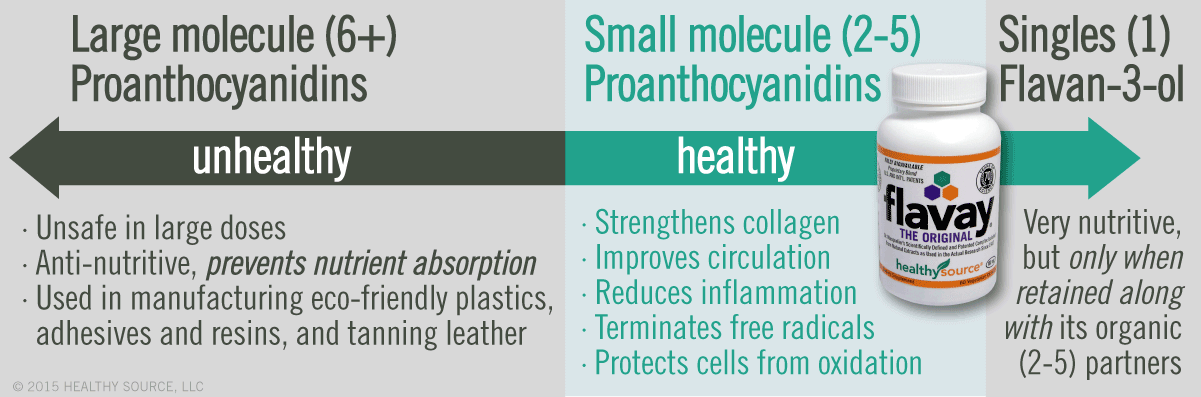
A: Flavay® is the original, highly specialized, nutritional
complex of pairs and triples of a specific molecule called "flavan-3-ol,"
isolated from natural extracts, and that has been extensively tested and
examined clinically for biological antioxidant protection, collagen strengthening,
tissue rebuilding and other health producing outcomes. (MORE...)
Q:Can the active ingredients in Flavay® be obtained in
food?
A:Yes and No. The active flavan-3-ol molecules in Flavay® can be found especially
in the fibrous and woody parts of naturally-ripened raw fruits
and vegetables and in the skins of seeds, nuts and fruits. Unfortunately,
our fruits and vegetables are typically deficient of these active polyphenol
molecules due to our modern methods of distributing food—which result
in fruits and vegetables that have been harvested while unripe. Another
cause for deficiency is cooking, which destroys the active polyphenols.
What's more, the skins of seeds, nuts and fruits are the parts of our
food that we generally discard or spit out.
Journal of the Science of Food and Agriculture (2000) reports there are no flavanols in commercially prepared juices. The processing and storage of the concentrated juices at room temperature destroys the flavanol molecules completely.
Actually, the best "food" source is red wine. The active principles
in Flavay® are at the center of the curious phenomenon known as
the "French Paradox." Red wine is a carrier of these healthy
polyphenols. So, why not just drink red wine to get your daily dose of
flavan-3-ol? Alcoholic beverages are not ideal as dietary supplements
due to potential abuse, dependency and toxicity as a result of over consumption.
And, while alcohol can compromise liver function, Flavay® actually
helps protect hepatic capillaries (the smallest blood vessels
in the liver) from free radical damage and activates liver antioxidant
enzyme systems. The point is that Flavay® provides specific protection
to the liver, and red wine does not.
So, while drinking some red wine is a reasonably healthy for most adults,
the best way to guarantee a consistent daily intake of flavan-3-ol polyphenols
is in its pure concentrated form: Flavay®.
A: After 70 years of human use, no adverse effects
have been observed. Furthermore, intensive biological, toxicological, pharmacological
and analytical research was conducted for the purpose of registration
as a medicine in France and other countries in Europe. In one study, daily
doses of up to 35,000 mg for six months were determined to cause no adverse
effects.
A: Flavay® helps protect hepatic capillaries (the smallest
blood vessels in the liver) from free radical damage and activates liver
antioxidant enzyme systems. A study of twenty patients with cirrhosis
of the liver showed that a daily intake of 300 mg of Flavay® can
help to decrease capillary fragility of the liver.
A:Flavay® has no known contraindications (conditions
under which it should not be used). Flavay® is completely safe and
nontoxic. In fact, clinical trials have been conducted in which pregnant
women (troubled by varicose veins and other circulatory problems in the
legs) safely used Flavay®. (MORE...)
Q:Should I consult with my doctor before taking Flavay®?
A: Yes, please consult your doctor before starting any course
of supplementation or diet change, particularly if you are currently under
medical care. If you have or suspect you may have a health problem, you
should consult your doctor.
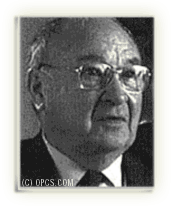
Flavay® is the product—used in the actual experiments—by
which Dr. Jack Masquelier patented the "radical
scavenger effect".
A:
Yes, Flavay® is manufactured using patented processes.
1948-1951: French patents described methods to extract the active
principles in Flavay® for the protection of the vascular system.
1964-1965: French patents for increasing efficiency of the manufacturing process, and a medicine patent for vascular protection.
1969: U.S. Patent No. 3,436,407 for manufacturing and for vascular protection.
1970: a new French patent for manufacturing in a state of purity that conforms with French pharmacopoeia standards.
1987: U.S. Patent No. 4,698,360 to describe the powerful antioxidant properties known as the "radical scavenger effect."
There are more patents, most are French.
Now consumers need to know that the marketplace is full of imitations,
various “extracts” and derivative forms of Dr. Masquelier’s
scientifically proven and pefected complex. Unfortunately, many have used
Dr. Masquelier’s name and research in unauthorized ways to promote
a myriad of derivations. In fact, the other "leading brand" pine
bark extract, compared to Flavay® below, is an offshoot derived from
Dr. Masquelier's authentic work and products. But, independent comparative
testing demonstrates that the initial qualifying research conducted on the
authentic products may not be automatically transferred to other commercial
products. (MORE...)
Q:Have proper research studies proven Flavay's® effectiveness?
A:
Yes, Flavay® is backed by 60 years of research
and human use and extensive testing for safety.
The original French and European brands were registered in France as over-the-counter
medications and it has therefore been consumed in Europe under medical supervision
for decades with no reports of adverse side effects. (MORE...)
Q:"What is the difference between the terms,
OPC and polyphenol? In some cases it appears synonymous and in others there
appears to be a distinction. On some labels it will say OPC, but in the
supplement facts, it says grape seed extract (vitis vinifera) 95% polyphenols.
I am confused."
A:It is confusing! and this is because these terms are used
inaccurately in the marketplace. "95% polyphenols" is a meaningless
expression in a scientific context. However, it does illustrate a problem:
In most cases, the following terms are used interchangeably for commercial
interests—or by mistake—and their differences have truly lost
all scientific meaning in the marketplace.
Therefore, when reading product labels, magazine articles and many popular
books, these scientific terms should be considered as generic words
and not scientific whatsoever. (MORE...)
Q:Are OPCs (oligomeric proanthocyanidins) the same as "grape
seed extract" or "pine bark extract" products?
A:Yes (in the marketplace) and No (in the scientific context).
Because of commercial interests—or by mistake— the terms,
OPCs and proanthocyanidins, have truly lost all of their scientific meaning
in the marketplace. In most cases, suppliers and retailers confuse grape
seed extracts as being synonymous with opcs or proanthocyanidins. (MORE...)
However, the terms are not the same in the scientific context. "Grape
seed extract" is a nonscientific term that has no specific meaning—other
than crushed seeds which can be toxic and oxidizing if not properly manufactured.
However, OPCs (short for oligomeric proanthocyanidins)
is the active ingredient that was discovered by Dr. Masquelier and proven
to have powerful antioxidant properties and other health producing benefits.
It's important to note that independent testing found no
active OPCs in a leading American brand of grape seed extract—even
though it's aggressively marketed as a branded OPC product. (MORE...)
Q:Is Flavay® the same as "grape seed extract"
or "pine bark extract"?
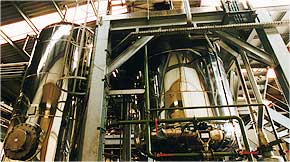
PHOTO: Dr. Masquelier's original and only industrial
manufacturing plant, located in Gardonne, France.
A:No.
"Grape seed extract" is a vague, nonspecific term that really
has no scientific value. In fact, crude "grape seed extract"
(and "pine bark extract") imitations are virtually worthless
to the consumer without active and naturally-derived oligomeric proanthocyanidins
with antioxidant capacity. Some of these extract products contain nothing
more than grape seeds or other plant parts which have been pulverized
in a food processor. (MORE...)
Flavay®, on the other hand, is a very specific molecular complex
which is scientifically defined and manufactured according to the original
process developed and patented by Dr. Jack Masquelier in France, approved
as an over-the-counter medicine in France and manufactured under the control
of French Pharmaceutical inspection.
Independent laboratory testing demonstrates that Flavay® scores
the highest as an antioxidant and as a free radical scavenger, which is
precisely the free radical scavenging effect that Dr. Masquelier established and documented. (MORE...)
Q:Is Flavay® the same as OPCs (oligomeric proanthocyanidins)
in the marketplace?
A:No.
OPCs (short for oligomeric proanthocyanidins)
is a term that covers many different and complex molecules. However, due
to commercial interests—or by mistake—the terms "OPCs"
and "proanthocyanidins" are often abused and misunderstood and
have therefore lost all of their scientific meaning in the marketplace.
(MORE...)
Independent testing found
no active OPCs in a leading American brand of "grape seed extract"—even
though it's aggressively marketed and branded as an OPC product.
(MORE...)
It's true that "OPCs" is the group of active principles that
is responsible for bringing the "grape seed extract" category
of products to fame. However, independent testing found no
active OPCsin a leading American brand of grape seed extract,
even though it's labeled and aggressively marketed as a branded OPC product.
(MORE...)
Consumers should also be aware that some manufacturers of grape seed
and pine bark extracts have devised ways to artificially boost the proanthocyanidin
numbers for their extracts in a test tube (in vitro, which is
outside the living body and in an artificial environment ). However, there
is no scientific research to show whether the human body benefits from
this artificial boost.
Flavay® is unique. Flavay® is derived from the
original manufacturing process developed and perfected by Dr. Jack Masquelier
in France, which captures the naturally-derived oligomeric proanthocyanidins
from their plant sources. For 60 years, each batch has been
routinely and extensively tested and analyzed to guarantee consistency,
potency and purity.
Independent laboratory testing demonstrated that Flavay® scores
the highest as an antioxidant and as a free radical scavenger, which is
precisely the free radical scavenging effect that Dr. Masquelier patented. (MORE...)
*Results vary by person and are not guaranteed. NOTE: We do not compensate
for our endorsements and testimonials. We do not consider paid testimonials to be nearly as valuable as comments
from customers who were not compensated and yet liked the products so much they gave their testimonials anyway.
† Statements made herein have not been evaluated by the Food and Drug Administration.
These products are not intended to diagnose, treat, cure or prevent any disease.